
Exploring the Leaning Tower of Pisa: An Architectural Marvel
Uncover the history, architecture, and cultural significance of the Leaning Tower of Pisa, an iconic symbol of Italy’s rich heritage and a must-see landmark.
Uncover the history, architecture, and cultural significance of the Leaning Tower of Pisa, an iconic symbol of Italy’s rich heritage and a must-see landmark.

Learn about the key features of mid century modern architecture, its historical context, and how it continues to influence contemporary design.

The Taj Mahal stands as a testament to the architectural ingenuity and artistic brilliance of the Mughal era. Located in Agra, India, this iconic mausoleum was commissioned in 1632 by the Mughal Emperor Shah Jahan in memory of his beloved wife Mumtaz Mahal. Its ethereal beauty and intricate design have captivated the hearts of millions, making it one of the most celebrated monuments in the world. In this article, we delve into the architectural splendor, historical significance, fascinating facts, and the ongoing preservation efforts for the Taj Mahal.
The Taj Mahal is a masterpiece of Mughal architecture, which is a synthesis of Indian, Persian, and Islamic styles. The monument is primarily constructed from white marble that reflects different hues throughout the day, creating a mesmerizing visual effect. The main structure is a symmetrical building with a large dome flanked by four minarets, each standing at approximately 40 meters high.
One of the most remarkable features of the Taj Mahal is its intricate marble inlay work, known as pietra dura. This technique involves the inlay of semi-precious stones into the marble, creating elaborate floral patterns and geometric designs. Additionally, the monument’s interior is adorned with calligraphy from the Quran, adding to the spiritual aura of the structure.
The construction of the Taj Mahal began in 1632 and took about 22 years to complete, with over 20,000 artisans and craftsmen working on the project. It serves as a monumental symbol of love, as it was built for Mumtaz Mahal, who passed away during childbirth. Beyond its romantic allure, the Taj Mahal also represents the zenith of Mughal architecture and reflects the empire’s wealth and power during the 17th century.
Over the centuries, the Taj Mahal has influenced various aspects of art and architecture around the world. It is a UNESCO World Heritage Site and is considered one of the New Seven Wonders of the World, underscoring its global cultural impact. Its image has been immortalized in various forms of media, making it a universal symbol of beauty and love.
Over the years, the Taj Mahal has faced several preservation challenges, including pollution, which has led to the yellowing of its pristine white marble. Various measures have been implemented to combat these issues, such as restricting vehicular emissions around the area and conducting regular cleaning and maintenance of the structure.
In recent years, the Archaeological Survey of India (ASI) has been active in implementing conservation projects to preserve the monument’s structural integrity and aesthetic appeal. These efforts include mud-pack therapy to clean the marble and the careful restoration of its intricate inlay work.
Despite these efforts, the Taj Mahal continues to face threats from environmental factors and overcrowding by tourists. As a result, international and local organizations are working collaboratively to ensure this architectural marvel remains preserved for future generations to admire.

Explore the definition, characteristics, and examples of brutalist architecture. Learn about its history and influence in modern design.

Kerning vs tracking explained with clear letter-pair and text-run examples. Learn when to adjust tracking, when to kern, and how font, case, size, and output affect spacing.

These shoe lace designs turn ordinary eyelets into reversible decorative patterns. For balanced everyday wear, start with straight-bar lacing; choose ladder or lattice when texture and grip matter more than quick adjustment. Star-like and two-tone arrangements create the boldest look but distribute pressure less evenly.
The paths below show exactly where each lace travels, which passes remain hidden, and where the finished tie sits. Use decorative patterns for casual shoes unless they still allow secure, even tightening.
Look down at the shoe and label the wearer’s left side L and right side R. Number each side from bottom to top: the eyelet nearest the toe is 1, followed by 2, 3, and so on. A six-pair shoe therefore has L1–L6 and R1–R6; an eight-pair shoe has L1–L8 and R1–R8.
Unless a pattern says otherwise, begin with both lace ends inside the shoe at the lowest pair. Center the lace so each end has about 15–20 cm available for the final tie. In the paths below, visible means the lace lies on top of the shoe, while hidden means it travels beneath the tongue or along the inside. Pull each pass snug, but do not fully tighten until the route is complete.
Required eyelets: Six pairs. Starting position: Lace ends inside at L1 and R1. Finished tie: The two ends emerge at L6 and R6.
The horizontal bars spread pressure broadly across the instep and give the most balanced tightening of these decorative options. They use a standard amount of lace and open quickly enough for ordinary daily wear. Because the hidden returns limit independent adjustment between sections, slip-on ease is moderate rather than exceptional.
Ladder required eyelets: Six pairs. Starting position: Ends inside at L1/R1. Finished tie: L6/R6.
Ladder lacing uses a moderate amount of lace. Its rails and rungs add friction, so the shoe feels grippier and less likely to loosen, but pressure can collect more at the horizontal rungs than with straight bars. Tightening takes a little longer, and putting the shoe on is moderately easy rather than fast.
Lattice required eyelets: Eight pairs. Starting position: Ends inside at L1/R1. Finished tie: L8/R8.
The lattice creates dense texture and holds firmly through repeated crossings, but it needs more lace than the six-pair patterns. Crossings make pressure less uniform and make quick loosening difficult. Expect slower tightening and slower entry, especially when the shoe is already snug.
Required eyelets: Six pairs. Starting position: Ends inside at L1/R1. Finished tie: L6/R6.
For a two-tone version, use two equal-length contrasting laces: thread one through route A and the other through route B, keeping both starts inside. Tie the two colors together at the top. This creates a dramatic star and makes the contrasting paths easier to see, but it uses extra lace and tightens unevenly. Diagonals can create concentrated pressure, while the crossed center slows entry and removal. Keep this arrangement casual-only; do not use it where reliable even tightening or secure fastening is critical.
For sport, work, hiking, or safety-critical footwear, use conventional lacing that lets you tighten each section evenly and finish with a secure knot. A decorative pattern should never prevent the shoe from holding the foot firmly without pressure points.

Chinese porcelain is one part of a broader history. Learn how ceramics from China developed through earthenware, stoneware, celadons, white wares, kilns, vessel forms, glazes, and decoration.

Learn how kinetic sculpture uses wind, gravity, motors, magnets, water, and viewers to animate three-dimensional art—and how speed, sound, balance, and chance reshape what you see.
Famous statues across history include radically different objects: prehistoric limestone figures, royal monuments, bronze civic icons, and deliberately ordinary manufactured forms. This representative selection follows how artists and cultures used three-dimensional art to express belief, power, identity, and new ideas about form.
A famous sculpture is not important only because it is recognizable. Its material, setting, subject, and influence explain why it continues to shape the history of sculpture.
Venus of Willendorf: Made by an unknown Gravettian artist in Central Europe, this small limestone figure dates to about 28,000–25,000 BCE. Found in present-day Austria, it emphasizes breasts, abdomen, and hips rather than facial detail. Its portable scale and simplified body make it an important early example of figurative carving, although its purpose cannot be proved as a fertility object.
Great Sphinx of Giza: Ancient Egyptian workers carved this monumental limestone figure around 2558–2532 BCE, probably during the reign of Khafre. Located beside the Giza pyramids, it combines a lion’s body with a king’s head. The union of animal strength and royal identity established a durable model for political and sacred monument-making.
Augustus of Prima Porta: This Roman marble statue, probably produced in the early first century CE after a bronze prototype, shows Emperor Augustus in military armor. Found near Rome and now associated with imperial portraiture, it uses the breastplate’s imagery to present Augustus as a victorious ruler and bringer of peace. Its idealized body helped define Roman state propaganda.
Terracotta Army: Craftspeople working for Qin Shi Huang created thousands of life-size terracotta soldiers around 210–209 BCE for the emperor’s mausoleum near Xi’an, China. Their varied faces, weapons, ranks, and horses suggest both individualized modeling and large-scale organization. The burial complex transformed sculpture into an image of an entire imperial system.
David: Michelangelo carved this monumental marble figure in Florence between 1501 and 1504. The biblical hero stands alert before his fight with Goliath, with a tense expression and controlled contrapposto. Its enlarged hands and head reinforce concentration, while its ideal anatomy made the statue a defining achievement of Renaissance humanism and a civic symbol of Florentine independence.
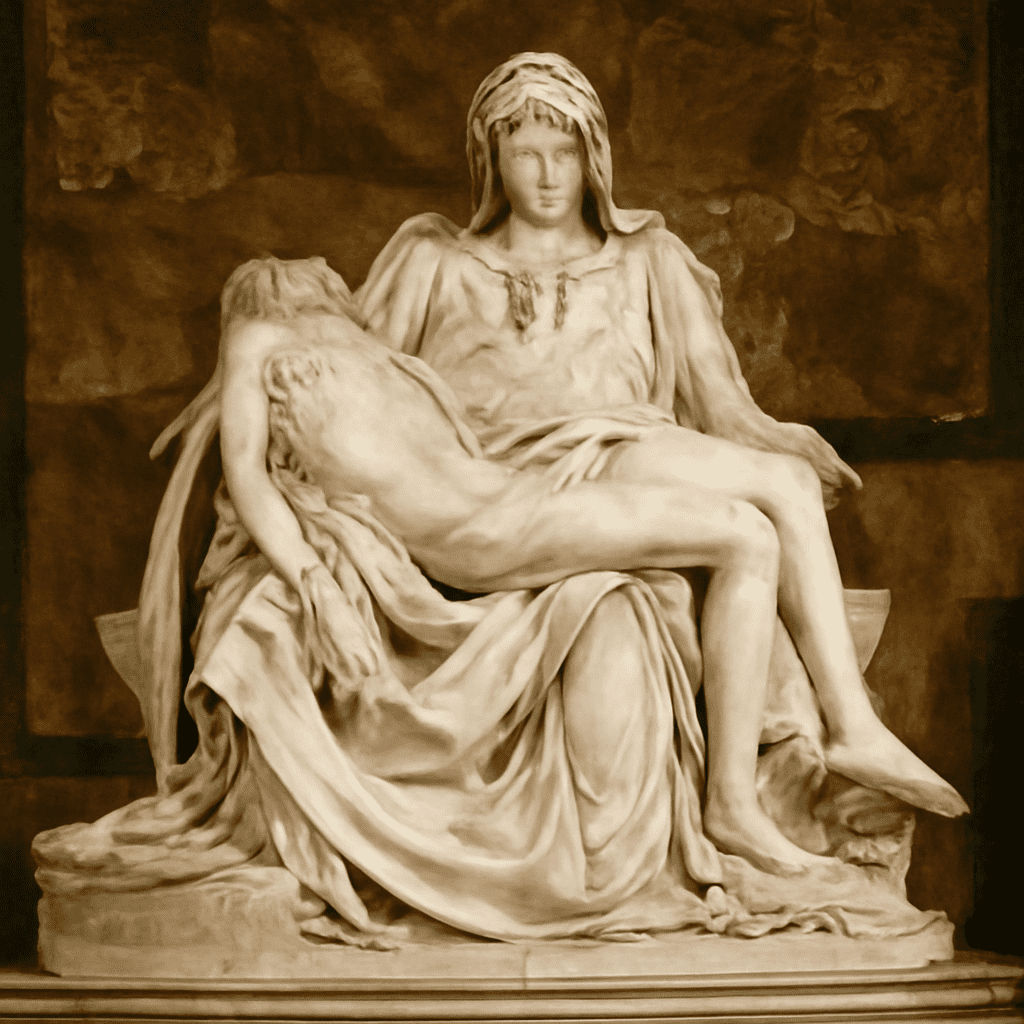
Pietà: Created in Rome around 1498–1500, this polished marble group shows the Virgin Mary holding the dead Christ in St. Peter’s Basilica. Michelangelo fits the figures into a stable pyramid while contrasting Mary’s youthful serenity with Christ’s limp body. The work’s refined surface, emotional restraint, and unified composition became a central model for later religious sculpture.
Moses: Michelangelo carved this marble figure in the early sixteenth century for the unfinished tomb of Pope Julius II; it now stands in San Pietro in Vincoli, Rome. The seated biblical lawgiver grips his beard and turns with contained energy. Horns derived from a Latin biblical translation and the statue’s powerful tension show how Michelangelo made a single figure carry theological and monumental force.
Statue of Liberty: Frédéric Auguste Bartholdi designed this copper repoussé figure, assembled over an iron framework engineered by Gustave Eiffel, between 1875 and 1886. Standing in New York Harbor, the personification of Liberty Enlightening the World holds a tablet and torch. Its scale, industrial construction, and public setting connected sculpture with engineering, immigration, and modern national identity.
The Burghers of Calais: Auguste Rodin modeled this bronze monument between 1884 and 1895 for a public site in Calais, France. It depicts six citizens walking to surrender themselves during the Hundred Years’ War. Instead of presenting one triumphant hero on a pedestal, Rodin gives each figure a distinct psychological response, changing the emotional language of civic monuments.
Bird in Space: Constantin Brâncuși developed this series in Paris from 1923, including highly polished bronze versions. The narrow, rising form reduces a bird to an impression of flight rather than a literal body. Its abstract simplicity helped establish that sculpture could convey movement and essence through reflective surface and vertical rhythm.
Guitar: Pablo Picasso’s 1912 construction in Paris used cardboard, paper, string, and wire rather than carved stone or cast metal. By assembling and cutting materials, Picasso turned a familiar instrument into a Cubist structure of planes and openings. The work helped introduce construction, collage, and mixed media as fundamental modern sculptural methods.
Fountain: Marcel Duchamp presented this manufactured porcelain urinal in New York in 1917 under the name “R. Mutt.” Though the original is lost, authorized replicas preserve its role as a readymade. By selecting and repositioning an ordinary object, Duchamp challenged the assumption that artistic skill, handcraft, and beauty were required for sculpture.
Compare these works through four practical questions:
Bead loom designs become easier to read when warp count, bead columns, rows, repeats, and centerlines map clearly. Learn to chart three motifs, keep edges clean, and resize or recolor them.