Famous Statues Across History: From Antiquity to Modern Art
Famous statues across history include radically different objects: prehistoric limestone figures, royal monuments, bronze civic icons, and deliberately ordinary manufactured forms. This representative selection follows how artists and cultures used three-dimensional art to express belief, power, identity, and new ideas about form.
A famous sculpture is not important only because it is recognizable. Its material, setting, subject, and influence explain why it continues to shape the history of sculpture.
Famous Statues That Shaped Later Traditions: the Venus of Willendorf, Egypt’s Great Sphinx, Rome’s Augustus, and China’s Terracotta Army
Venus of Willendorf: Made by an unknown Gravettian artist in Central Europe, this small limestone figure dates to about 28,000–25,000 BCE. Found in present-day Austria, it emphasizes breasts, abdomen, and hips rather than facial detail. Its portable scale and simplified body make it an important early example of figurative carving, although its purpose cannot be proved as a fertility object.
Great Sphinx of Giza: Ancient Egyptian workers carved this monumental limestone figure around 2558–2532 BCE, probably during the reign of Khafre. Located beside the Giza pyramids, it combines a lion’s body with a king’s head. The union of animal strength and royal identity established a durable model for political and sacred monument-making.
Augustus of Prima Porta: This Roman marble statue, probably produced in the early first century CE after a bronze prototype, shows Emperor Augustus in military armor. Found near Rome and now associated with imperial portraiture, it uses the breastplate’s imagery to present Augustus as a victorious ruler and bringer of peace. Its idealized body helped define Roman state propaganda.
Terracotta Army: Craftspeople working for Qin Shi Huang created thousands of life-size terracotta soldiers around 210–209 BCE for the emperor’s mausoleum near Xi’an, China. Their varied faces, weapons, ranks, and horses suggest both individualized modeling and large-scale organization. The burial complex transformed sculpture into an image of an entire imperial system.
Michelangelo Statues: David, Pietà, and Moses as Individual Masterpieces
David: Michelangelo carved this monumental marble figure in Florence between 1501 and 1504. The biblical hero stands alert before his fight with Goliath, with a tense expression and controlled contrapposto. Its enlarged hands and head reinforce concentration, while its ideal anatomy made the statue a defining achievement of Renaissance humanism and a civic symbol of Florentine independence.
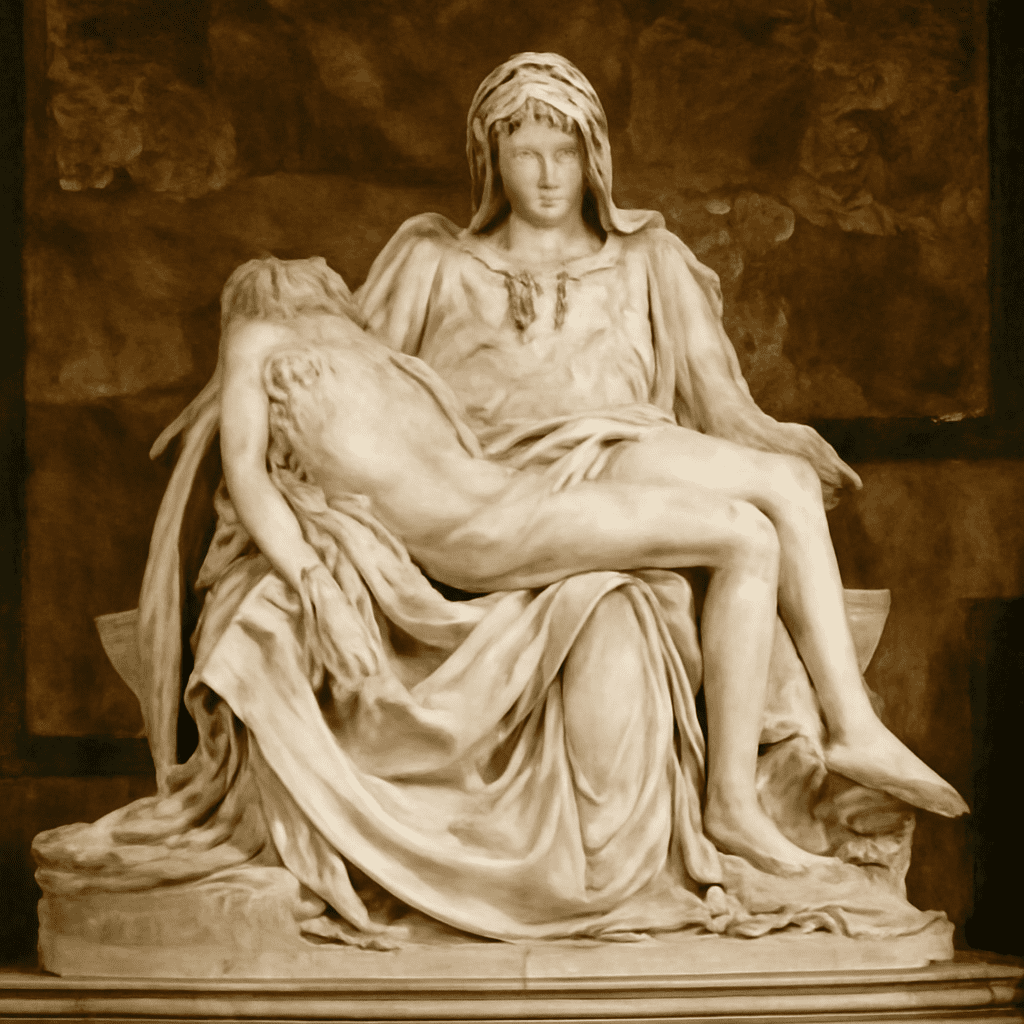
Pietà: Created in Rome around 1498–1500, this polished marble group shows the Virgin Mary holding the dead Christ in St. Peter’s Basilica. Michelangelo fits the figures into a stable pyramid while contrasting Mary’s youthful serenity with Christ’s limp body. The work’s refined surface, emotional restraint, and unified composition became a central model for later religious sculpture.
Moses: Michelangelo carved this marble figure in the early sixteenth century for the unfinished tomb of Pope Julius II; it now stands in San Pietro in Vincoli, Rome. The seated biblical lawgiver grips his beard and turns with contained energy. Horns derived from a Latin biblical translation and the statue’s powerful tension show how Michelangelo made a single figure carry theological and monumental force.
Monuments and Sculpture in Public Space: Bartholdi’s Statue of Liberty and Rodin’s The Burghers of Calais
Statue of Liberty: Frédéric Auguste Bartholdi designed this copper repoussé figure, assembled over an iron framework engineered by Gustave Eiffel, between 1875 and 1886. Standing in New York Harbor, the personification of Liberty Enlightening the World holds a tablet and torch. Its scale, industrial construction, and public setting connected sculpture with engineering, immigration, and modern national identity.
The Burghers of Calais: Auguste Rodin modeled this bronze monument between 1884 and 1895 for a public site in Calais, France. It depicts six citizens walking to surrender themselves during the Hundred Years’ War. Instead of presenting one triumphant hero on a pedestal, Rodin gives each figure a distinct psychological response, changing the emotional language of civic monuments.
Famous Sculpture Beyond the Carved Figure: Brâncuși’s Bird in Space, Picasso’s Guitar, and Duchamp’s Fountain
Bird in Space: Constantin Brâncuși developed this series in Paris from 1923, including highly polished bronze versions. The narrow, rising form reduces a bird to an impression of flight rather than a literal body. Its abstract simplicity helped establish that sculpture could convey movement and essence through reflective surface and vertical rhythm.
Guitar: Pablo Picasso’s 1912 construction in Paris used cardboard, paper, string, and wire rather than carved stone or cast metal. By assembling and cutting materials, Picasso turned a familiar instrument into a Cubist structure of planes and openings. The work helped introduce construction, collage, and mixed media as fundamental modern sculptural methods.
Fountain: Marcel Duchamp presented this manufactured porcelain urinal in New York in 1917 under the name “R. Mutt.” Though the original is lost, authorized replicas preserve its role as a readymade. By selecting and repositioning an ordinary object, Duchamp challenged the assumption that artistic skill, handcraft, and beauty were required for sculpture.
How to Look Beyond Fame: Material, Scale, Context, and Influence
Compare these works through four practical questions:
- Material: Does limestone, marble, bronze, terracotta, copper, or a found object determine the work’s texture and durability?
- Scale: Was it designed for the hand, a tomb, a temple complex, a museum, or a city harbor?
- Context: Does the subject serve ritual, burial, political authority, civic memory, religious devotion, or artistic provocation?
- Influence: Did the work establish a new body type, monument format, construction method, or definition of what sculpture could be?