Famous Still Life Paintings: How Everyday Objects Become Art
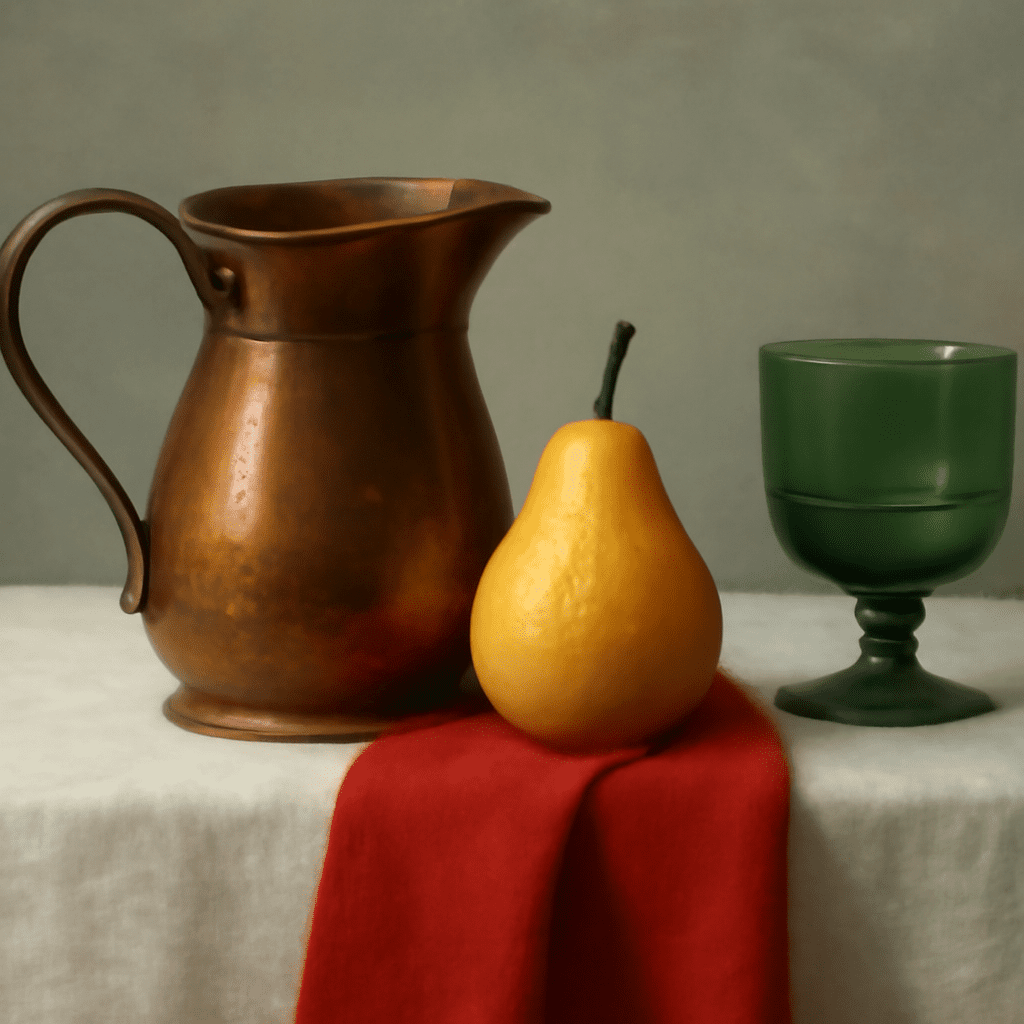
A lemon peel curls over the edge of a table, drawing the eye from a bright surface into the space below. In a still life, a small detail like that can organize an entire picture. Well-known paintings of arranged objects invite viewers to notice how fruit, vessels, flowers, and cloth acquire weight and meaning through the choices of a painter.
The following examples of still-life art move from a seventeenth-century meditation on mortality to modern experiments with color and form. They offer a route into the genre through selected works rather than a complete ranking of its artists.
Still Life Examples and the Basics of the Genre
What is a still life painting? It is a picture focused on inanimate objects, often arranged by the artist or observed together in a setting. A bowl, a book, a flower cut from its stem, or a piece of fruit can become the subject. The arrangement may be casual or ceremonial; the objects and their relationships hold the attention.
A portrait centers on a person, while a landscape typically takes a place or environment as its principal subject. A painting can cross those boundaries: a figure may stand beside a carefully rendered table, and objects can tell part of a larger story. In a still life, however, the objects themselves carry the central visual interest.
The genre gives artists control over scale, placement, and light. A glass near the edge of a table can create tension; a folded cloth can lead the eye from one piece of fruit to another. A painter of still lifes constructs the view through placement and the treatment of the painted surface.
Pieter Claesz: Objects and Mortality
The celebrated still-life painter Pieter Claesz made Still Life with a Skull and a Writing Quill in 1628, bringing a skull together with writing materials and other objects. The restrained palette and close arrangement encourage the viewer to move slowly across differences in surface: bone, paper, and the reflective material of a vessel.
The Metropolitan Museum of Art places the picture within the vanitas tradition, in which objects prompt reflection on mortality and the passing nature of worldly activity. The skull is a direct reminder; the tools of writing connect the idea to learning and human work. Their meaning depends on the grouping as well as on any individual object.
These still life examples show why a subject list alone is not enough. A skull beside a quill creates a different relationship from a skull shown alone. The painter’s composition allows one object to affect the way another is read.
Vincent van Gogh: Flowers and Paint
A well-known still-life example is Sunflowers by Vincent van Gogh; this 1888 painting presents a vase filled with blooms against a pale yellow background. Some heads open toward the viewer, while others droop or turn. The flowers vary in stage and shape, making the bouquet feel both exuberant and vulnerable to time.
The National Gallery describes the work’s thick paint and close variations of yellow. The vase holds the arrangement together, but the brushwork makes the surface active: petals, seed heads, and background share a warm color family while remaining visibly different in texture.
Among famous still life paintings, this version also has a particular domestic setting in its history. Van Gogh made it for the room prepared for Paul Gauguin in the house they shared in Arles. Its flowers can be understood as a welcome as well as an exercise in color, without requiring every bloom to carry a single fixed meaning.
Paul Cézanne: A Table Built With Color
The celebrated still-life painting Dish of Apples, made by Paul Cézanne around 1876–77, gathers fruit, a dish, and a folded napkin into a dense tabletop arrangement. The Met identifies the painting’s setting in the house of the artist’s father in Aix. The napkin rises behind the fruit, giving the collection of rounded forms a larger shape against the background.
Look at how the apples differ from one another. Their colors shift across red, green, and yellow, while the light cloth separates some forms and brings others together. Instead of treating a table as a neutral platform, Cézanne lets folds, edges, and fruit build the structure of the picture.
For still life artists, a familiar object can become a way to test how color creates volume and how forms fit together. The subject remains recognizable, but attention moves from the identity of an apple to the arrangement of shapes across the canvas.
Compare the Objects, Then the Composition
These examples of the still life genre reward different kinds of attention. Claesz places objects in a relationship that can suggest the limits of life; van Gogh gives flowers a setting shaped by friendship and vivid paint; Cézanne makes a group of apples and cloth into an exploration of form. The objects are tangible in each work, but their purposes and visual effects differ.
When looking at other celebrated paintings of still life, begin with the objects and then trace the spaces between them. Notice which item is largest, where the light falls, and whether the surface looks smooth or heavily worked. A crowded arrangement may ask the eye to travel across many small details; a sparse one may make the interval between two vessels as significant as either object.
Painters of still-life subjects can also use familiar things to address ideas beyond the tabletop. Meaning may come from a documented setting, an established convention, or the visible relationship between objects. Those clues help distinguish an evidence-backed interpretation from a private association a viewer brings to the image.