Picasso Painting Guernica: Reading the Figures and Forms
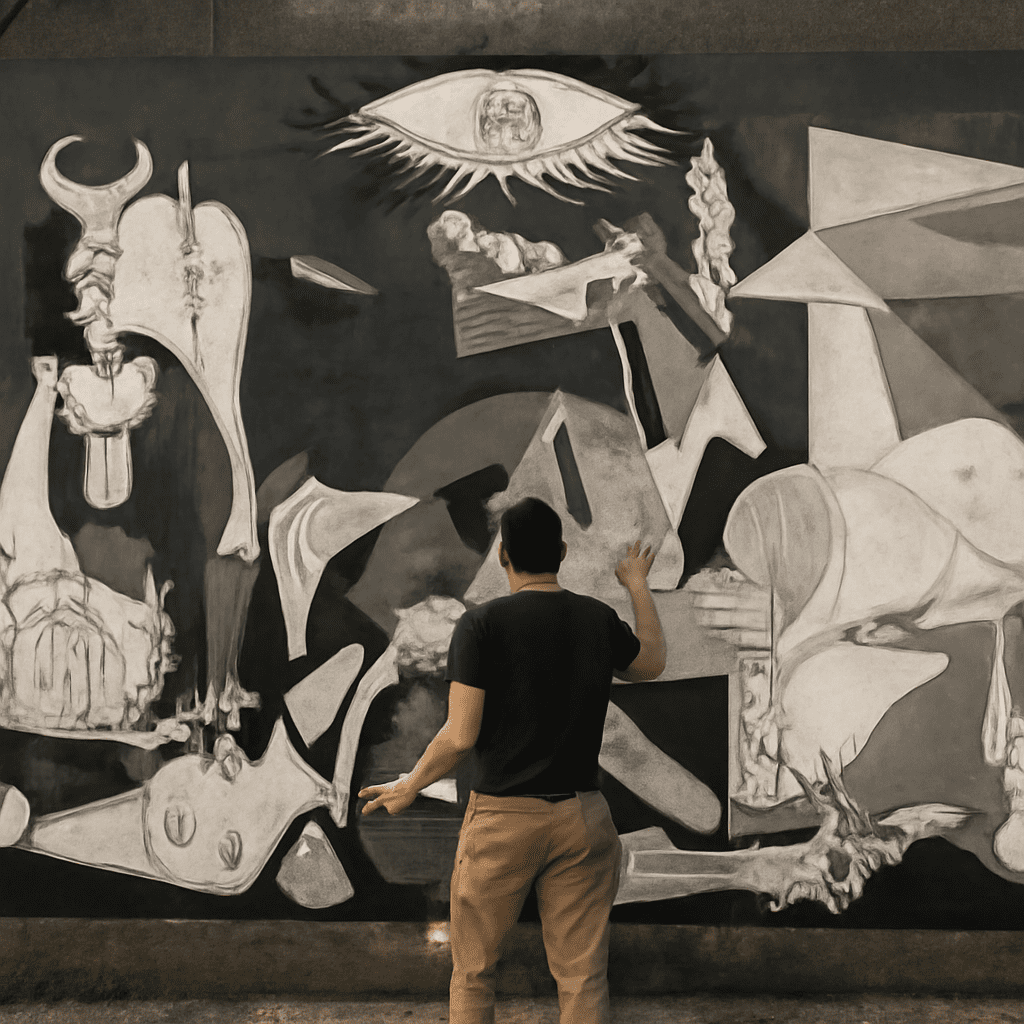
A horse screams at the center of a crowded interior. A mother holds a lifeless child, a fallen figure lies below, and a light shines over the scene. In Picasso’s painting Guernica, these fragments form a powerful image of suffering that rewards a slow look across the canvas.
An analysis of Guernica begins with both its visual structure and the event that prompted it. Pablo Picasso painted the enormous work in 1937, after the bombing of the Basque town of Gernika during the Spanish Civil War. The scene does not reproduce a street or a moment of the attack; it translates catastrophe into a concentrated arrangement of bodies, animals and light.
Guernica analysis: From the bombing to the canvas
On April 26, 1937, German and Italian aircraft bombed Gernika in support of the Nationalist forces fighting Spain’s Republican government. The attack devastated the town and killed civilians. The Museo Reina Sofía’s research archive connects the painting to that event and documents the work’s history.
The Republican government had already commissioned Picasso to create a work for Spain’s pavilion at the 1937 Paris International Exposition. After the bombing, he began developing Guernica in his Paris studio. Its subsequent display in the pavilion brought a response to the war before an international audience.
Dora Maar photographed the canvas as it changed. Her images document the Picasso painting Guernica as it evolved, revealing revisions to its figures and composition. The museum’s account of her photographs records the appearance of the mother and child, bull, horse and fallen figure in the painting’s early stages. The finished canvas was the result of decisions made over weeks, rather than a single spontaneous gesture.
How the figures hold the composition together
Pablo Picasso’s Guernica is wide enough to take in as a field of separate encounters. At the left, a woman throws back her head as she holds her child beneath a bull. Near the center, the horse twists and opens its mouth; underneath lies a dismembered figure whose hand grips a broken sword. To the right, women reach, move and cry out beneath a light-bearing arm.
Examining Guernica’s composition reveals a broad triangular arrangement of these figures. The horse anchors the middle, while angled bodies and limbs direct attention inward from both sides. Yet the figures also press against the edges of their compartments. Sharp fragments of walls and bodies make the space feel compressed, as if the scene cannot comfortably contain the events taking place within it.
Looking from left to right is useful, but the eye keeps returning to connections across the picture: a raised head answers another open mouth; the light above the horse links the central group to the figure entering from the right. In this reading of Picasso’s Guernica, the repeated gestures turn individual distress into a shared visual rhythm.
Why black, white and gray matter
A close reading of Guernica also reveals how the absence of bright color makes contrasts between light and dark carry much of its force. Pale faces and limbs stand out against black shapes; a white horse cuts through a darker central field. Different gray tones keep adjacent fragments distinct while binding the scene into a single surface.
The restricted palette has often been connected to the newspaper photographs through which Picasso learned of the bombing. That connection is an interpretation of his visual choices, not a complete explanation of them. In the painting itself, black, white and gray also help the eye distinguish overlapping bodies and follow the hard edges of the architecture.
Scale matters too. This Spanish Civil War painting stretches across a wall, placing its figures close to the viewer’s own space. The format gives the mourning mother and the horse a physical presence that a small reproduction can only suggest. Its large size also allows several actions to unfold at once without merging into one indistinct crowd.
What do the bull, horse and light mean?
The animals invite interpretation, but each should first be considered in relation to the visible scene. The bull stands above the mother and child; the horse occupies the center, its body pierced and its head raised. Some readings associate the bull with brutality and the horse with suffering, but their meanings have been debated. Treating either animal as a fixed code can flatten the tension between its posture, setting and the figures around it.
The electric bulb and the lamp held by a woman add another contrast. Both illuminate the scene, yet their sharp shapes do little to make it feel safe. They can suggest exposure or witness; the painting leaves room for different readings. A careful Guernica analysis separates such interpretations from the documented bombing and commission.
Picasso’s Guernica, a mural about the Spanish Civil War, gains its force from this combination of historical specificity and open visual language. Picasso’s response to Gernika names an event, while its fractured figures let viewers consider suffering beyond a single literal scene.
Where can the original be seen? Guernica belongs to the Museo Reina Sofía in Madrid; the museum’s collection page provides information about the work and its display.