Napoleon Art: How Painters Designed an Image of Power
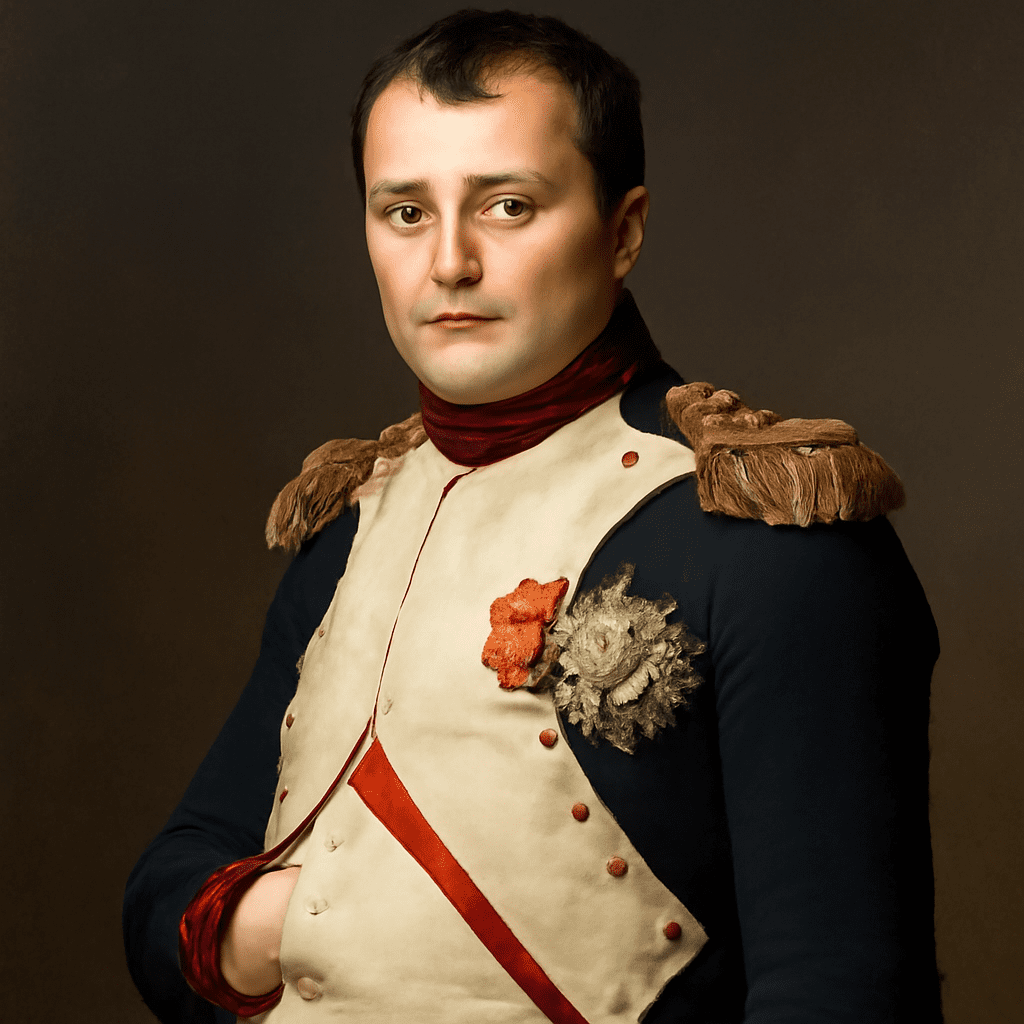
A visitor comparing two images of Napoleon Bonaparte crossing the Alps might be surprised to find a rearing horse in one and a mule in the other. Both are paintings about Napoleon, but they present different ideas of leadership. Recognizing those choices helps turn a familiar historical image into a more complicated visual argument.
From a mountain pass to an imperial study, portraits of Napoleon Bonaparte were constructed for particular audiences and moments. Clothing, gesture and setting can suggest courage, authority or tireless work, even when the scene should not be taken as a literal record of what happened.
Napoleon Bonaparte Painting: The Heroic Mountain Crossing
Jacques-Louis David’s image of Bonaparte crossing the Great St. Bernard Pass presents a commanding figure on a rearing horse. The rider points ahead as his cloak moves in the wind; the horse’s raised forelegs and the diagonal sweep of the composition make the ascent look dramatic. The Palace of Versailles identifies its version as an 1802 work depicting the crossing of May 20, 1800.
Bonaparte was First Consul at the time of the campaign, before he became emperor in 1804. David’s painted portrait of Napoleon Bonaparte turns a military journey into a public statement about leadership. A steady face and controlled gesture contrast with the animal’s energy, suggesting a commander who remains composed amid danger. Soldiers and equipment in the distance give the scene a collective setting, but the foreground concentrates attention on one figure.
The first version was commissioned by Charles IV of Spain as a diplomatic portrait; David produced several versions. The Louvre’s account of the Malmaison version places the commission in the context of relations between Spain and France. The Versailles canvas should therefore be identified as one version, rather than treated as the only painting of the subject.
Paul Delaroche: A Different Kind of Crossing
Paul Delaroche revisited the Alpine crossing decades later. His Bonaparte Crossing the Alps, painted in 1848 and held by the Louvre, shows Bonaparte on a mule, accompanied by a guide. Wrapped against the cold, he appears less like an emblem of effortless mastery than a traveler confronting a difficult route.
A Louvre record for a preparatory study describes Delaroche’s intention to evoke historical truth through the mule and Bonaparte’s troubled expression, in contrast to David’s animated horse and composed rider. That intention should not make the later painting a photograph of the event: it too is a carefully selected and staged image, created long after the crossing.
The contrast shows how paintings of Napoleon can reshape the same subject. Delaroche’s depiction of Napoleon Bonaparte offers a later perspective on the leader. David enlarges the rider’s gesture and the drama of the horse; Delaroche draws attention to weather, terrain and the vulnerability of a body making the journey. Each image leads the eye toward a different account of power.
The Emperor at Work
In David’s The Emperor Napoleon in His Study at the Tuileries (1812), the stage changes from a mountain to an interior. Napoleon stands beside a desk in military uniform, one hand tucked into his waistcoat. Papers, books, a sword and an ornate chair surround him; the clock reads after four, and a candle has burned low. The National Gallery of Art, which holds the portrait, reads these details as part of an image of a ruler working through the night.
This oil portrait of Napoleon Bonaparte combines several roles. The uniform and sword evoke a military leader, while the papers suggest administration and law. The room’s furniture and imperial emblems establish status without requiring a throne. The effect is quieter than the Alpine image, but the pose remains deliberate: Napoleon appears to pause from work and face the viewer.
This Napoleon Bonaparte painting was commissioned by a Scottish admirer, the marquis of Douglas. The gallery’s teaching material notes that Napoleon likely did not pose for it. The apparent intimacy of the study is thus another composed public image, not evidence that the artist witnessed this particular night.
A Ceremony Made Monumental
David’s Coronation of Napoleon offers a third setting: the public ceremony at Notre-Dame in Paris on December 2, 1804. The Louvre’s collection record dates its monumental canvas to 1807 and records later retouches in 1808. Napoleon stands at the center, raising a crown above the kneeling Joséphine, while clergy, family members and dignitaries fill the surrounding space.
The painting of Napoleon stages power through a crowd rather than a solitary figure. This image of Napoleon in art places him at the center of an imperial court. Architecture, ceremonial dress and the arrangement of witnesses give the moment grandeur and structure. The painting was commissioned by Napoleon, so the image is also part of how the regime wanted its ceremony remembered; it is a designed representation of an event, not a neutral transcript of everything that occurred.
Reading the Images Together
Napoleon art can be read by looking first at who commissioned a work, when it was made and which version is being shown. The portraits of Napoleon painted by David during his rule served different purposes from Delaroche’s later retrospective scene. Their poses and settings frame the ruler as heroic commander, diligent administrator or ceremonial sovereign.
The differences are visible before a viewer reads a label. A raised arm on a mountain, a hand inside a waistcoat and a crown held above another figure each direct attention in a different way. Comparing these depictions of Napoleon Bonaparte shows how painters could use a body, an object and an imagined space to make political authority persuasive.