The Arnolfini Marriage: A Closer Look at Van Eyck’s Portrait
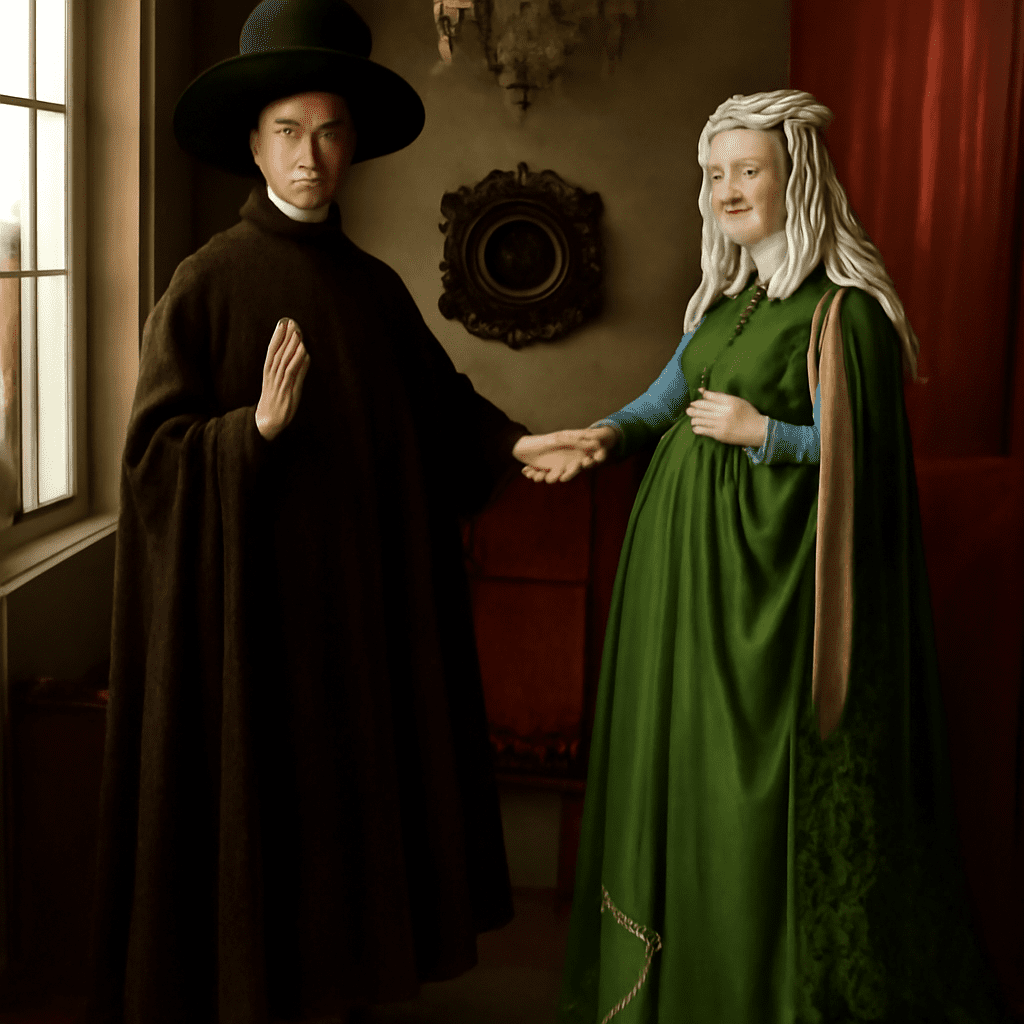
A man and woman join hands in a richly furnished room, while a small dog stands at their feet. Jan van Eyck’s Arnolfini Portrait has often been associated with an Arnolfini wedding, yet its precise occasion remains uncertain. The painting rewards close looking before any single story is imposed on its details.
Made in 1434, the double portrait of the Arnolfini couple is an oil painting on oak in London’s National Gallery. Its careful rendering of cloth, metal and reflected light gives a convincing sense of presence, while the room’s mirror introduces another view and several questions about who is present.
Arnolfini Double Portrait: Who Are the Sitters?
The National Gallery’s collection record identifies the man as probably Giovanni di Nicolao di Arnolfini, an Italian merchant active in Bruges, and the woman as probably his wife, whose identity is unknown. Several members of the Arnolfini family lived in Bruges, making identification less straightforward than the familiar name suggests.
The gallery considers the pair to be Arnolfini and his spouse, but that does not establish that the picture records their wedding. An older Arnolfini marriage interpretation treated the image as evidence of a ceremony. The museum no longer accepts that reading of the Arnolfini wedding as a settled description, and its scholarly catalog examines the evidence and competing proposals in detail.
Referring to the figures as Arnolfini and his bride can imply that a wedding is taking place. A more cautious description of the Arnolfini double portrait is a portrait of a couple probably married to one another. Likewise, calling the woman the bride of Arnolfini suggests an unconfirmed ceremony. Their hands are joined; an Arnolfini wedding remains unproven.
The Room and Its Rich Materials
The figures who may be Arnolfini and his spouse stand between a window and a bed hung with red fabric. Oranges sit near the window, a brass chandelier hangs above, and wooden overshoes lie on the floor. The woman’s green gown falls in generous folds and is trimmed with pale fur. These surfaces give the painter opportunities to describe different textures, from polished metal to heavy cloth.
They also suggest prosperity. According to the National Gallery, the objects were chosen to convey the couple’s wealth and standing. The bed does not necessarily make the setting a private bedroom in the modern sense: a fine bed could appear in a room used to receive guests. The objects help construct a portrait of social position as well as a convincing interior.
The woman gathers her gown in front of her. Although its rounded outline is sometimes read as a sign of pregnancy, the gallery explains that she is lifting the ample fabric in a fashionable manner. The appearance of the dress is not reliable evidence that she was expecting a child.
The Mirror and the Painter’s Presence
At the center of the back wall hangs a convex mirror. It reflects the room from the opposite direction: the backs of the principal figures appear at its edges, and two small figures stand in a doorway behind the viewer’s apparent position. Tiny scenes from the Passion of Christ surround the glass. The mirror gives the Arnolfini pair’s portrait a second route through the room.
Above it, an elaborate Latin inscription states that Jan van Eyck was there and gives the year 1434. One reflected figure may be the artist, but the identity of the two people in the mirror is not certain. The inscription and reflection invite a story about presence; they do not by themselves prove that Van Eyck acted as a legal witness to a wedding.
This distinction matters to the Arnolfini marriage debate. The gallery’s catalog notes that the inscription’s wording was not the formula used for legal witnesses. What can be seen is an unusual signature and a carefully painted reflection; the legal meaning once assigned to them remains an interpretation rather than a fact established by the image.
Details, Symbols and Technique
The dog, shoes, fruit and candle have attracted interpretations in discussions of the Arnolfini wedding scene. A dog, for example, can suggest fidelity, while shoes have been connected to ideas about sacred ground. Such associations can enrich a reading of the Arnolfini couple’s marriage portrait, but they are not labels supplied by the artist. A detail may also contribute to the display of wealth, the atmosphere of the room or the visual pleasure of precise observation.
Oil paint helped Van Eyck render these differences in surface. The National Gallery’s artist profile describes his use of translucent layers to depict light and materials. The gleam on the chandelier differs from the soft weight of fur and the sheen of the mirror, yet each is coordinated with the light entering from the window.
Scientific examination adds another layer to this portrait of Arnolfini and his wife. Infrared images show changes beneath the surface, and the gallery notes that several objects, including the dog and chandelier, were added at a later stage of the painting process. The finished scene feels immediate, but it was also carefully constructed and revised.
Does the Painting Show a Wedding?
The joined hands make a ceremony an understandable possibility, and the picture has long been associated with Arnolfini’s marriage. Describing the woman as the merchant Arnolfini’s bride assumes more than the evidence can establish. The National Gallery, however, does not treat it as a confirmed ceremony. The painting remains a double portrait of a probably married couple whose exact identities, occasion and individual symbols continue to invite research.