Greece Art: Exploring the Legacy of Ancient Greek Artwork and Architecture
The legacy of Greece art stands as a foundation for Western aesthetics and cultural ideals. From the geometric simplicity of early pottery to the monumental grandeur of temples and the lifelike representation in sculpture, ancient Greek artwork set enduring standards of beauty, proportion, and innovation. The achievements in both art and architecture from ancient Greece remain visible in countless museums, public buildings, and art academies across the world, continuing to inspire generations.
The Origins and Evolution of Greece Art
Greece art traces its roots to the Bronze Age civilizations of the Cyclades, Minoans, and Mycenaeans. Early Greek artwork, dating from the 9th century BCE, displayed geometric motifs on pottery, with simple shapes and recurring patterns. These early forms emerged during the so-called Geometric period (c. 900–700 BCE), when Greek artists developed a visual language focused on symmetry and abstract design.
The subsequent Orientalizing period (c. 700–600 BCE) brought new influences from the Near East and Egypt. Artisans incorporated exotic creatures, floral motifs, and curvilinear forms, signaling a growing openness to external ideas. The Archaic period (c. 600–480 BCE) marked a major shift, as Greek sculptors began to experiment with naturalism and proportion. The iconic kouros and kore statues, with their rigid postures and enigmatic smiles, reflect this transitional stage between abstraction and realism.
The Classical period (c. 480–323 BCE) is often regarded as the pinnacle of ancient Greece art. During this era, artists achieved remarkable advances in anatomical accuracy, perspective, and expressive form. The Late Classical and Hellenistic periods (c. 400–31 BCE) pushed these innovations further, introducing dynamic movement, emotional intensity, and complex compositions in both sculpture and painting. Throughout these centuries, art and architecture evolved not in isolation, but alongside evolving political, philosophical, and religious ideas.
Key Characteristics of Ancient Greece Art and Architecture
Ancient Greece art and architecture are defined by several distinctive characteristics, which together form the basis of their enduring appeal. One of the most prominent qualities is the pursuit of idealized beauty—Greek artists strove for perfection in proportion, symmetry, and harmony. This was evident not only in sculpture, but also in the design of temples and public spaces.
Greek sculpture is famous for its lifelike representation of the human body. Sculptors such as Phidias and Polykleitos established canons of proportion, believing that mathematical ratios could create the perfect form. The contrapposto stance, in which figures appear relaxed with weight shifted onto one leg, revolutionized the depiction of motion and anatomy.
In architecture, the Greeks introduced three major orders: Doric, Ionic, and Corinthian. Each order is distinguished by specific column styles and decorative elements. The Doric order, with its sturdy columns and simple capitals, is seen in the Parthenon. The Ionic order features slender columns and scroll-like capitals, as in the Erechtheion. The ornate Corinthian order, with its acanthus leaf motifs, became popular in later periods and influenced Roman and Renaissance architecture.
Pottery played a crucial role in everyday Greek life and artistic expression. Vases were decorated with scenes from mythology, daily activities, and athletic contests, rendered in either black-figure or red-figure techniques. Greek artists also excelled in mosaic and fresco painting, although few original examples survive today. Across all media, the Greeks valued clarity, balance, and narrative power.
Famous Ancient Greek Art: Masterpieces and Their Stories
Several examples of famous ancient Greek art stand as icons of world heritage, each with its own story and significance. The Parthenon, built between 447 and 432 BCE on the Athenian Acropolis, is the quintessential achievement of Greece art and architecture. Designed by architects Iktinos and Kallikrates with sculptures directed by Phidias, the Parthenon epitomizes Classical ideals: mathematical harmony, optical refinements, and a narrative frieze depicting the Panathenaic procession.
The Venus de Milo (Aphrodite of Milos), discovered on the island of Milos in 1820, is another exemplar of Greek sculpture. Created around 130 BCE during the Hellenistic period, this marble statue is celebrated for its sensuous pose, intricate drapery, and enigmatic beauty, despite its missing arms. The work is believed to depict Aphrodite, goddess of love, capturing both serenity and allure.
The Discobolus (Discus Thrower), sculpted by Myron in the 5th century BCE, embodies the Greek interest in athletics and the ideal human form. The bronze original is lost, but numerous Roman marble copies survive, showing a perfectly balanced athlete caught in the moment of action. This piece exemplifies how ancient Greek artists captured both motion and psychological focus in their work.
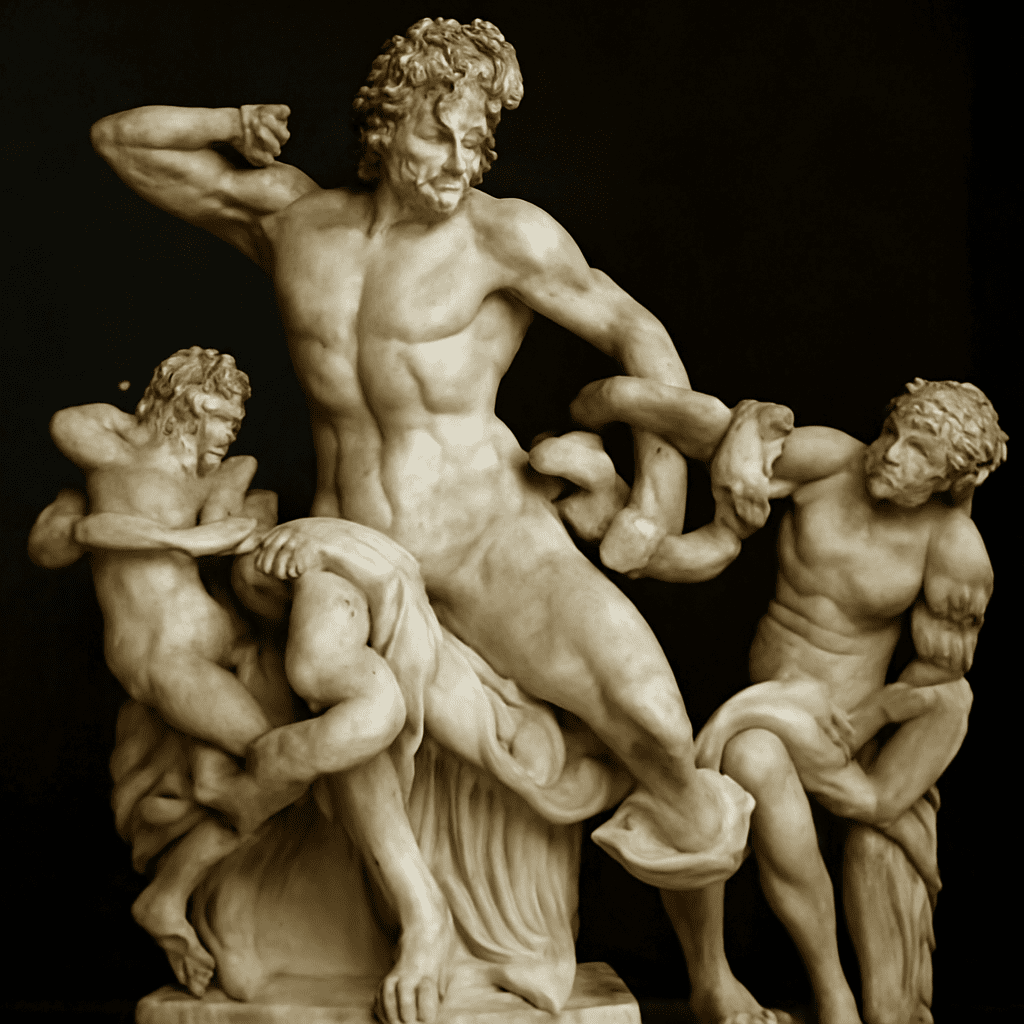
Other masterpieces include the Laocoön and His Sons—a dramatic Hellenistic sculpture illustrating the agony of the Trojan priest Laocoön—and the friezes of the Temple of Zeus at Olympia, which narrate mythological battles in intricate relief. Each of these works demonstrates the Greek commitment to technical excellence and expressive storytelling in art.
The Lasting Influence of Greek Artwork on Western Art
The impact of Greek artwork on Western art cannot be overstated. During the Roman era, Greek originals and their copies were widely admired, collected, and emulated. Roman architects and sculptors adopted Greek orders and compositional rules, ensuring the survival and spread of Greek artistic principles throughout the empire.
During the Renaissance, a renewed interest in classical antiquity led artists like Michelangelo and Raphael to study and replicate ancient Greek models. The pursuit of anatomical accuracy, harmonious proportions, and narrative clarity in Renaissance painting and sculpture owes a direct debt to ancient Greece art and architecture. This influence is equally visible in neoclassical movements of the 18th and 19th centuries, which revived Greek forms in buildings like the British Museum and the U.S. Capitol.
Modern artists, architects, and designers continue to draw inspiration from Greek ideals. The use of columns, pediments, and proportional systems remains standard in civic buildings. The depiction of the human figure in art schools is grounded in Greek canons of beauty and anatomical learning. Even in contemporary abstraction, the Greek emphasis on composition and balance persists. Through its innovations, masterpieces, and philosophical foundations, Greece art endures as an essential source of creativity and meaning in Western civilization.