Types of Quilt Patterns: From Traditional Blocks to Modern Designs
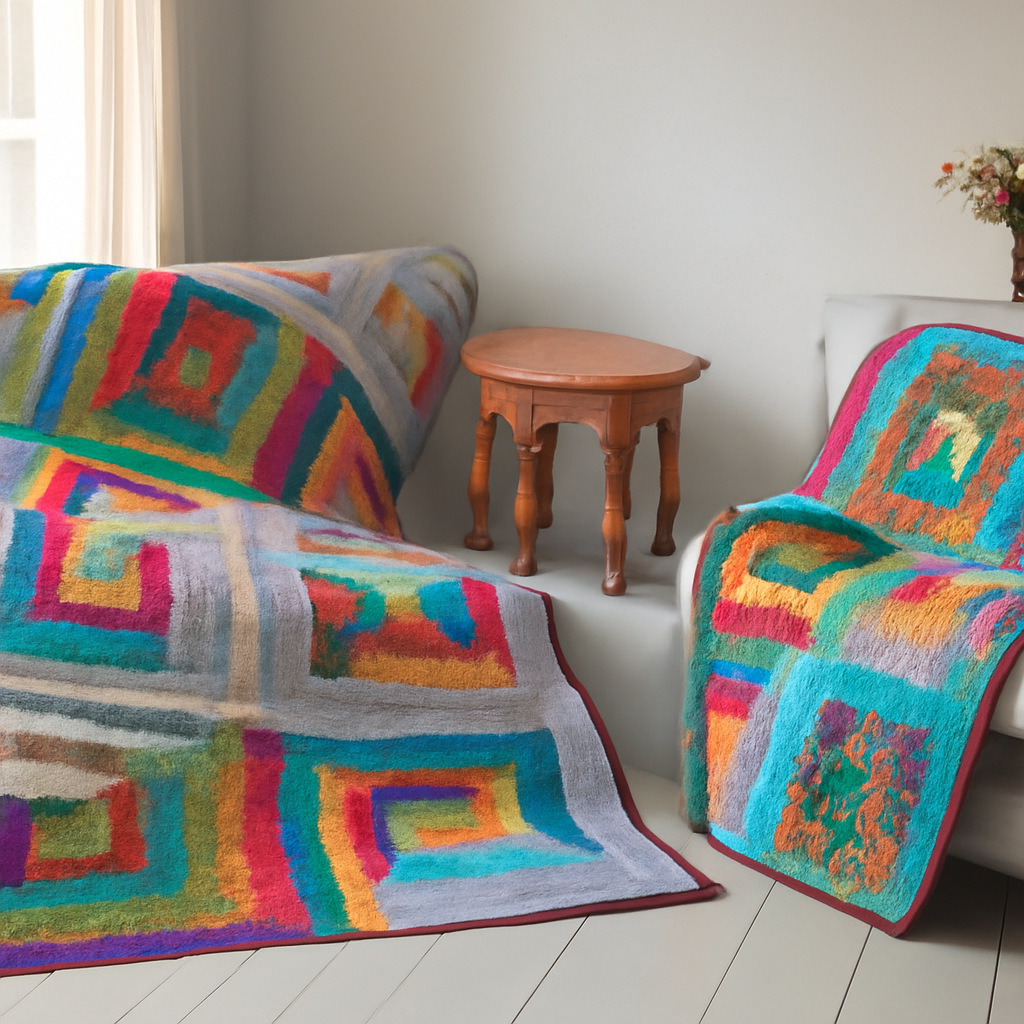
The main types of quilt patterns are pieced blocks, appliqué, foundation-pieced, medallion, row, whole-cloth, and improvisational designs. These labels describe how fabric shapes are joined or arranged. A quilt can combine them: a medallion may contain appliqué, while a modern quilt may enlarge a traditional star block and surround it with negative space.
To recognize a pattern, separate its construction from its composition. Construction tells you how fabric is cut and joined; composition tells you how units are positioned; quilting design describes the stitches added afterward.
Types of Quilt Patterns by Construction and Composition
Most quilt designs can be classified by the action that creates the surface or by the layout that organizes it.
- Pieced block patterns use cut fabric units sewn into blocks, then repeated, alternated, or varied across the quilt.
- Appliqué patterns place fabric shapes on a background with stitching or adhesive, creating motifs that do not depend on a grid of seams.
- Foundation-pieced patterns use a paper or fabric foundation to control small pieces, sharp points, and complex angles.
- Medallion and row patterns describe layout: one grows around a center, while the other arranges blocks or motifs in bands.
- Whole-cloth patterns use one broad fabric surface, with quilting or appliqué supplying the main structure.
- Improvisational patterns are assembled without a fixed repeat, using decisions made during cutting and sewing.
These categories overlap. A pieced pattern can use repeated blocks, a medallion setting, or rows, while a whole-cloth quilt can use either a centered or all-over composition. Construction types answer how the top is assembled; composition types answer how the eye travels across it.
How Quilt Designs Are Built: Pattern, Setting, and Quilting
Pattern, block, setting, and quilting design are related, but they are not interchangeable.
The piecing or appliqué pattern is the cutting, sewing, or appliqué plan: it specifies shapes, seam allowances, placement, and sometimes assembly order. A block is one repeatable or stand-alone unit within that plan, such as a Log Cabin, Nine-Patch, or star.
Block setting is the way blocks or other units are arranged in the finished top. Straight settings place blocks edge to edge; sashing separates them with strips; an on-point setting turns them diagonally; alternating plain blocks create breathing room. Blocks can also be staggered, framed, or set at different sizes.
Quilting design is the stitched surface pattern, not the piecing. Crosshatching, outline or echo quilting, grids, feathers, and free-motion motifs may be added to any top. Stitches can reinforce the composition by repeating a seam, tracing an appliqué shape, or filling background space.
Thus, a quilt may have a traditional star pattern, an asymmetrical setting, and dense echo quilting.
Appliqué, Foundation, Medallion, Row, and Whole-Cloth Approaches
Appliqué, foundation, medallion, row, and whole-cloth approaches differ in both technique and layout.
Appliqué attaches fabric shapes to a background rather than constructing every form from seams. Shapes may be raw-edge, turned-edge, fused, or needle-turned; the resulting pattern often reads as a motif, scene, or bold silhouette.
Foundation piecing, including paper piecing, sews fabric onto a temporary or permanent foundation in a prescribed order. The foundation stabilizes small pieces and produces accurate points, sharp angles, and irregular geometry. It is recognizable by numbered sections or a printed sewing guide.
A medallion quilt builds outward from a central block or motif. Borders may change technique, scale, or color, so the center remains the visual anchor.
Row quilts organize blocks, strips, or appliquéd motifs in horizontal or vertical bands. Rows can repeat evenly or vary in width, making this format useful for orderly themes and long, graphic shapes.
Whole-cloth work starts with one unpieced piece of fabric, so quilting and appliqué create the structure or focal pattern. Dense stitching, trapunto, or marked motifs can produce relief without a patchwork grid.
These approaches can be combined: foundation-pieced blocks may form rows, or appliqué may sit at the center of a medallion.
Improvisation and What Makes Modern Quilt Designs Modern
Modern quilt designs are defined less by a ban on traditional blocks than by how familiar parts are edited and composed. A traditional Flying Geese, star, or log-cabin unit can become modern through scale, spacing, color, or an unexpected setting.
Enlarged scale turns a single block or simple shape into the main event. Oversized units reduce seam density and make geometry legible from across a room; tiny repeated units can create the opposite effect, a textured field.
Negative space—unpatterned fabric around or between motifs—creates pause, contrast, and hierarchy. It may isolate one block, offset a cluster, or give bold quilting room to show.
Limited palettes, often two or three dominant colors plus neutrals, clarify relationships between shapes. Color placement can make one unit appear to move, break a grid, or form a secondary image.
Alternate grids and asymmetry replace a regular block matrix with staggered rows, floating units, asymmetrical borders, oversized rectangles, or deliberate gaps. The construction may remain conventionally pieced even when the composition feels open and architectural.
Improvisation adds another route: the maker cuts and joins without a fixed repeat, responding to neighboring shapes, seams, and color. Useful controls still matter—repeat a color, align a few edges, or reserve negative space—so the result has rhythm rather than random noise.
When comparing quilt designs, first identify the construction method, then the setting, and finally the quilting lines. That sequence reveals whether the visual character comes from the blocks, their arrangement, the stitched texture, or a purposeful combination.