Greek Column Styles: Doric, Ionic, and Corinthian
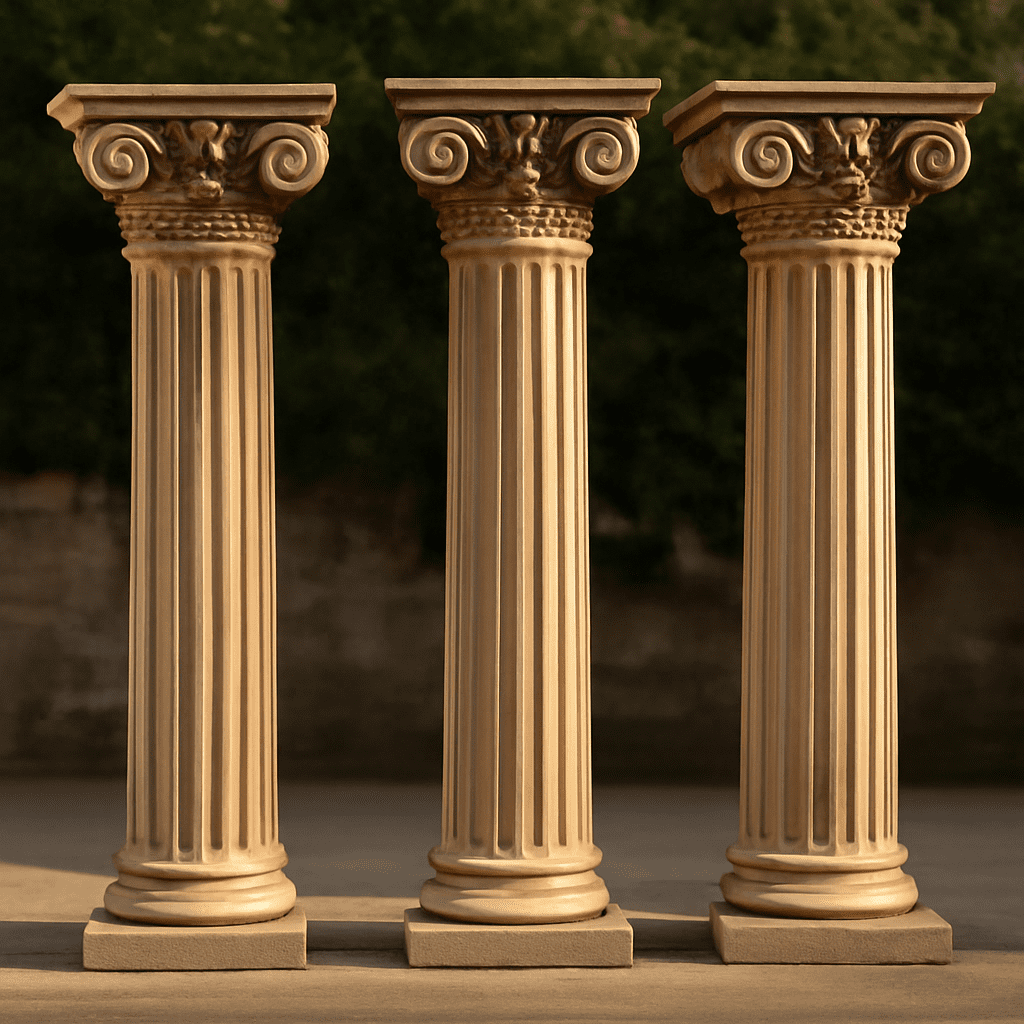
The Greek column styles most commonly identified in classical architecture are Doric, Ionic, and Corinthian. You can usually distinguish them by starting at the bottom: check whether the shaft has a base, how slender it is, and how its fluting is shaped. Then inspect the capital and the entablature above it.
The three types of Greek columns overlap in later buildings, so a capital alone can mislead. A plain capital is not automatically Doric, and a leafy capital is not necessarily an original Greek Corinthian example. Use several visible features together, especially when examining Roman copies, neoclassical buildings, or mixed designs.
Greek Column Styles: First Check the Base and Proportions
Begin at the column’s lowest visible point. In the canonical Greek orders, a Doric column generally rises directly from the stylobate, or stepped platform, without a separate base. Ionic and Corinthian columns normally stand on a molded base made from rounded and sometimes square-edged profiles. Later architects sometimes gave Doric columns bases, so this is a strong clue rather than an absolute rule.
Next, compare height with width. Doric shafts look comparatively sturdy and carry a strong visual weight. Ionic shafts are taller and more slender, while Corinthian shafts are usually at least as slender as Ionic ones. Look also at the fluting: vertical grooves make the shaft appear lighter, but their number and profile can vary between periods and buildings.
- Doric: usually no separate base, sturdy shaft, simple capital, and often about 20 broad flutes.
- Ionic: molded base, slender shaft, typically 24 flutes, and a capital with scroll-like volutes.
- Corinthian: molded base, slender shaft, often finely fluted, and a deep capital covered with acanthus leaves.
Also scan above the capital. Doric entablatures commonly show alternating triglyphs and metopes in the frieze. Ionic entablatures more often use a continuous sculpted or plain frieze. Corinthian entablatures generally follow Ionic patterns, although later versions may be much more elaborate.
Doric Columns: Plain Capitals and Sturdy Proportions
Doric columns are the most visually weighty of the three principal Greek orders. Their shafts taper subtly toward the top and usually have broad, sharply cut flutes separated by narrow arrises. The shaft typically meets the stylobate without a distinct base, creating a direct, grounded appearance.
The Doric capital has two main visible parts. The lower echinus is a rounded, cushion-like molding; above it sits the square abacus, which supports the entablature. From a distance, the capital may look plain, but its curved echinus and squared abacus are important identifying details. It is not simply an undecorated block.
Above the capital, the frieze is often the clearest supporting clue. Triglyphs are vertically grooved blocks, usually placed between sculpted or plain metopes. If a column has a sturdy shaft, no obvious base, an echinus-and-abacus capital, and a triglyph-and-metope frieze, Doric is the strongest match.
Ionic Columns: Volutes, Bases, and Slender Shafts
Ionic columns are recognized most quickly by their volutes: paired spiral scrolls that project from the capital. Viewed from the front, the volutes resemble coiled disks; viewed from the side, the capital may appear narrow. This directional quality matters because an Ionic capital can look different from different angles.
The shaft normally stands on a distinct molded base and is more slender than a Doric shaft. Its fluting is usually numerous and finely spaced, often with rounded strips between the grooves. The shaft may taper gently, and the overall effect is lighter and more elegant than the Doric order.
Do not rely on volutes alone. Some later interpretations simplify or enlarge them, while a damaged capital may lose its scrolls. Confirm the diagnosis with the base, slender proportions, and entablature. A continuous frieze, rather than a regular sequence of triglyphs and metopes, often supports an Ionic identification.
Corinthian Columns: Acanthus Leaves and Ornate Capitals
Corinthian columns have the most elaborate capital among the three Greek column styles. Instead of a simple echinus or prominent volutes, the capital rises through several tiers of carved acanthus leaves. The leaves curl outward and may support small volutes or corner ornaments near the top.
The shaft is generally slender and stands on a molded base, much like an Ionic column. It is commonly fluted, and the transition from shaft to capital is deeper and more decorative. In a clear photograph, the dense foliage is usually the fastest way to identify Corinthian.
Even here, context matters. Later Roman and neoclassical builders frequently enlarged, stylized, or rearranged the acanthus decoration. A capital with leaves may also belong to a later hybrid or a decorative variation rather than a canonical Greek Corinthian building. Check for the base, shaft proportions, and the form of the entablature before treating the foliage as decisive.
A Quick Identification Sequence for the 3 Types of Greek Columns
- Find the bottom. If the shaft appears to rise directly from the platform, consider Doric first. If it rests on a separate molded base, compare Ionic and Corinthian.
- Measure the visual proportion. A relatively thick, forceful shaft favors Doric. A tall, narrow shaft favors Ionic or Corinthian.
- Read the shaft surface. Broad, strong flutes support Doric; finer, more numerous flutes support Ionic or Corinthian. Treat flute counts as typical patterns, not fixed rules.
- Inspect the capital from more than one angle. A rounded echinus and square abacus suggest Doric; spiral volutes indicate Ionic; layered acanthus leaves indicate Corinthian.
- Use the entablature as a check. Triglyphs and metopes reinforce Doric. A continuous frieze supports Ionic or Corinthian, though Corinthian examples may carry richer ornament.
- Account for the building’s date and mixture of details. Roman copies, Renaissance and neoclassical versions, restorations, and mixed-order buildings may add a base to a Doric column, simplify volutes, or combine a Corinthian capital with another order’s proportions.
When only the capital is visible, record the result as a likely identification rather than a certainty. The most reliable reading comes from the combination of base presence, shaft slenderness, fluting, capital design, and entablature.