How a Rose Window Turns Stone and Glass Into Light
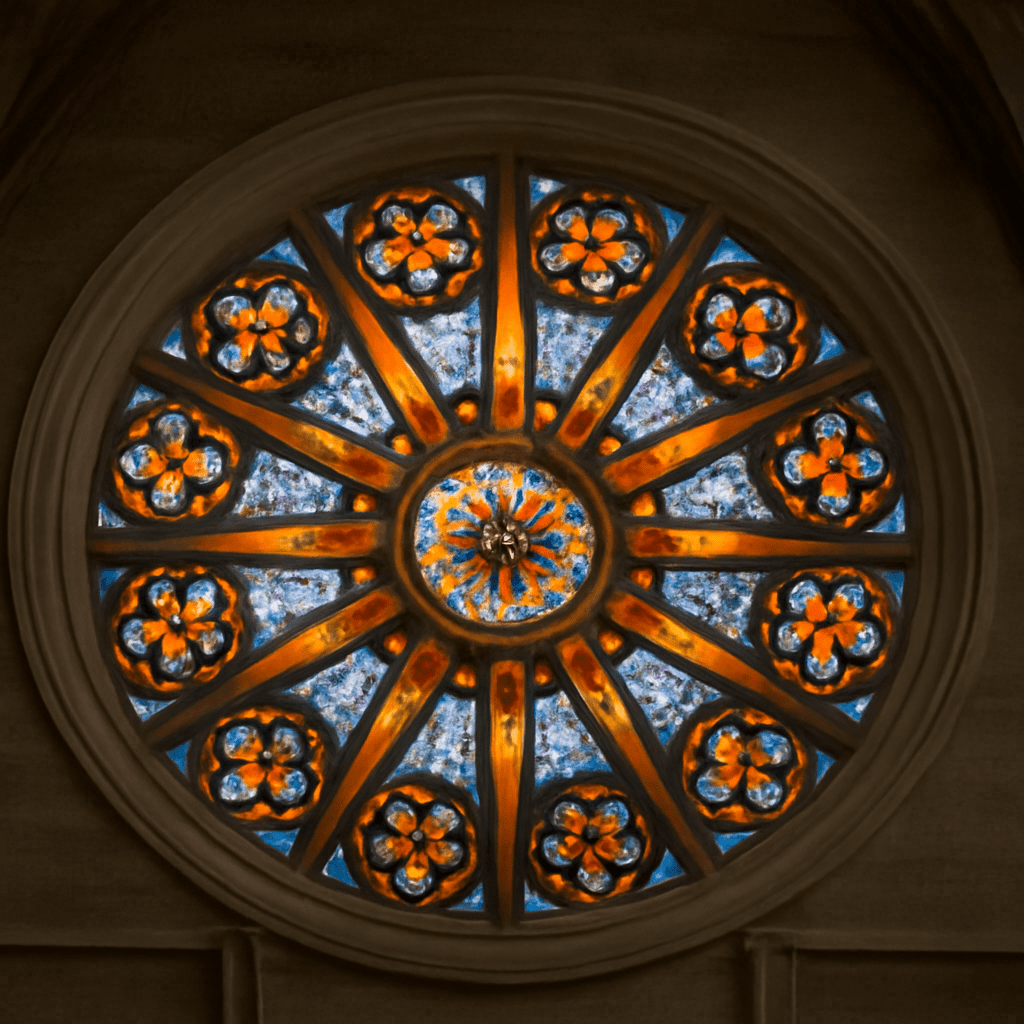
A rose-shaped cathedral window can look like a single luminous image from the floor below. Move closer, however, and the circle resolves into a carefully ordered structure: stone divisions frame small pieces of colored glass, while the building’s orientation determines how daylight reaches them.
At Notre-Dame in Paris, three great circular windows offer distinct ways to read that relationship. Their positions above the western entrance and across the transept make a walk through the church a lesson in scale, pattern, and changing light.
Cathedral rose window: the structure behind the color
The first element to follow is the outer stone ring. Within it, slender stone members, known as tracery, divide the opening into smaller shapes. Some radiate from the center like spokes; others curve into lobes or rings. The design gives the eye a route through a complex surface, from a central medallion outward to the edge.
In rose-shaped windows, the stonework also provides a framework for the glazing. Individual pieces of colored glass are joined with strips of lead, or cames, into panels. Painted lines and shading add faces, folds of clothing, and other details; metal supports help hold the panels in place. Seen from inside, the dark lead lines make figures legible against the brighter glass, much as an outline organizes a drawing.
A rose window depends on the wall around it as well as the pieces within it. A broad opening must be accommodated in the masonry, so the circle belongs to a larger composition of arches, supports, and façade. From outside, the stone pattern is often easier to read; inside, transmitted daylight gives the glass its color and makes the imagery more prominent.
Three positions, three encounters
The west window sits above the main entrance. Completed around 1225, it is the smallest of the three great circles. On entering, a visitor can turn back toward the doors to see the circle within the architectural frame of the west wall. From the square outside, its place in the façade is clear, though the glass is less luminous than it appears from within. The Friends of Notre-Dame de Paris describes its position and date.
The north and south windows face each other across the transept, the crosswise arm of the church. Each is set high in an end wall, above a band of tall windows. Their height makes the circular outline visible across the interior, while the distance encourages the viewer to read the overall arrangement before searching for individual figures.
The Notre Dame Cathedral rose window on the north side centers on Mary and the Christ Child, surrounded by figures from the Old Testament. Notre Dame rose windows share a circular format, yet this northern example has retained almost all its original 13th-century stained glass, according to the Friends’ account of the glass. The tracery makes a sequence of compartments around the central image; the sequence can be followed even when the smaller faces are difficult to distinguish.
Across the crossing, the south window was a gift from King Louis IX. Its strong reds contrast with the blues associated with the northern glass. Light entering from different directions changes the apparent intensity of the colors through the day, and cloud cover can soften the contrast. The south window has also been extensively restored, including work in the 18th and 19th centuries, so its present appearance carries the history of those interventions.
The three great rose-shaped windows survived the 2019 fire, although survival did not mean that centuries of weathering disappeared. The Friends of Notre-Dame de Paris records the survival of the stained glass and describes the need to address accumulated damage. The north and south windows therefore invite comparison as works with different histories of preservation as well as different colors.
Reading the circle on a visit
Begin at a distance where the whole opening fits comfortably into view. Notice whether the central figure is surrounded by one ring or several, and where the stone spokes meet the outer rim. Then look at a single compartment: its shape sets the boundaries of a scene, while lead lines organize the smaller pieces of glass within it.
Notre Dame cathedral’s rose windows reward a second look from the crossing, where the northern blue field can be seen in relation to the tall glazing below. From there, turn toward the southern glazing of Notre Dame Cathedral and compare the pattern of colored compartments across the space. These cathedral windows, shaped like roses, express the same architectural idea through two orientations and two histories of repair.
Finally, let the eye return to the stone rather than the figures. Trace one spoke from the center until it branches, and follow the curve it forms with its neighbors: that small junction shows how a large circle becomes a coherent pattern of individual glazed openings.