Nativity Facade Sagrada Familia: How to Read Two Stories in Stone
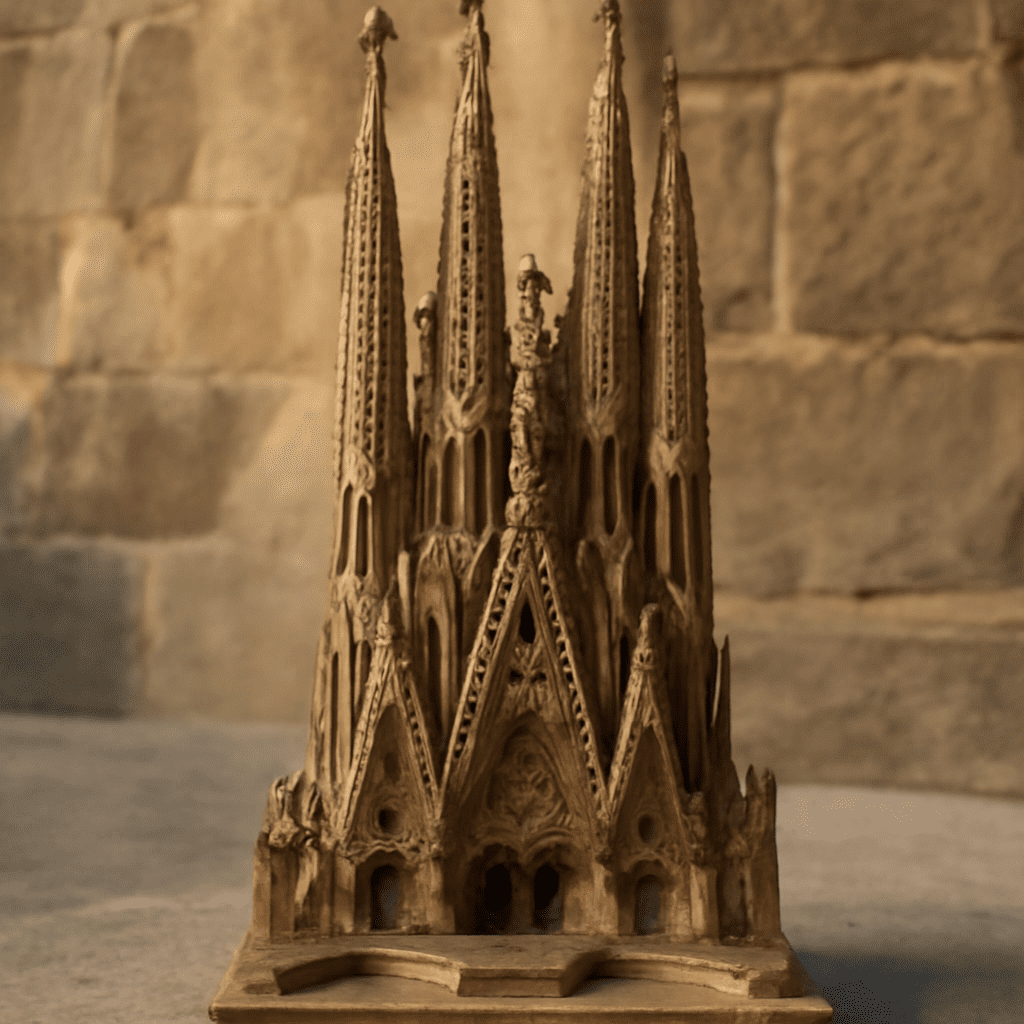
A cypress tree rises above the doorway, its branches sheltering white doves. Around it, angels, plants and people crowd the stone. This is the Nativity front of Sagrada Familia, where the birth of Jesus is set within an exuberant vision of life.
Across the basilica, the Passion front tells a later and darker story. Its angular figures stand among powerful sloping columns, with open stretches of stone giving each gesture room to register. Reading the two elevations begins with their different treatment of the human body and the space around it.
A Birth Surrounded by Life
The Nativity facade Sagrada Familia visitors see faces east, toward the rising sun. Its three portals are dedicated, from left to right, to Hope, Charity and Faith. The large central portal brings the birth story into focus: Mary and Joseph flank the infant Jesus, with the ox and mule nearby. Shepherds and Magi arrive to pay homage, while angels sing and play instruments above them.
On this birth-themed entrance, these figures are part of a dense surface in which details compete for attention. Leaves and flowers grow around the scenes, and animals appear at different scales. The eye moves from a human face to a bird, then to the folds of a robe or a cluster of foliage. This abundance makes creation itself seem to participate in the celebration.
On Gaudí’s eastern front, above the central portal, the cypress represents the tree of life; its white doves suggest shelter and welcome. Lower down, a pelican feeding its young symbolizes Christ giving himself as spiritual nourishment. The details carry meaning individually, but their close grouping also creates an overall impression of growth. A visitor can first read the entrance as a lively whole, then pick out one story at a time.
The outer portals on the Nativity side widen the narrative. On the left, the Flight into Egypt shows the Holy Family leaving to protect the child. On the right, the young Jesus appears working as a carpenter and later teaching in the temple. These are scenes of danger, work and learning as well as celebration; they extend the account beyond the moment of birth.
Passion Facade Sagrada Familia: A Drama in Angular Stone
The Passion facade Sagrada Familia visitors encounter is organized around three portals and four bell towers, like its counterpart. Six inclined columns support a great porch, with a pediment above. The architecture establishes a stark frame for scenes of Christ’s suffering and death, while the upper level introduces the Resurrection.
For this Passion entrance, sculptor Josep Maria Subirachs created the main groups between 1986 and 2010, working in a language of sharp edges and emphatic volumes. Faces and bodies are simplified into planes; bent limbs and tilted heads make emotion legible from a distance. The Sagrada Familia Passion facade uses the space around these figures as part of the composition, allowing a single action to stand apart from its neighbors.
The sequence leads through the final events of Jesus’s life. The Last Supper, the kiss of Judas and the trial are followed by the journey toward crucifixion. The basilica’s account identifies the sculptural groups and their place in the story. Rather than trying to absorb every figure at once, a viewer can follow the scenes across the lower levels and upward toward the crucified Christ.
Near the kiss of Judas is a square of numbers. Its rows and columns add to 33, traditionally associated with Jesus’s age at his death. It is a small, orderly device beside a moment of betrayal: the grid offers a pause amid the movement of bodies. Above, the Empty Tomb group belongs to the Resurrection story, carrying the narrative beyond the Crucifixion.
Two Visual Languages, One Basilica
Both elevations use sculpture to make biblical stories visible on the exterior. Their shared arrangement of portals and towers gives each a recognizable architectural frame. The difference lies in how that frame is filled. On one side, figures and living things gather into a richly textured surface; on the other, isolated groups and angular cuts give the episodes a more severe dramatic force.
The Sagrada Familia Nativity facade began in Gaudí’s lifetime, and his work there is included with the crypt in UNESCO’s listing of his architecture. Its present appearance also includes later contributions: Etsuro Sotoo’s nature-inspired bronze doors were installed in 2014 and 2015. Their colored foliage continues the theme of living forms while belonging to a later stage of the project.
Gaudí began designing the opposite elevation in 1911, but its major sculpture is Subirachs’s later interpretation. The contrast therefore reflects two artistic hands as well as two moments in the Christian narrative. Neither is simply a decorative screen: each uses its sculpture and architectural setting to guide the viewer through a story.
For a quick distinction, look at the figures: a crowded garden of rounded life points to the birth story; sparse, angular bodies within a severe stone frame point to the Passion.